The Iliad
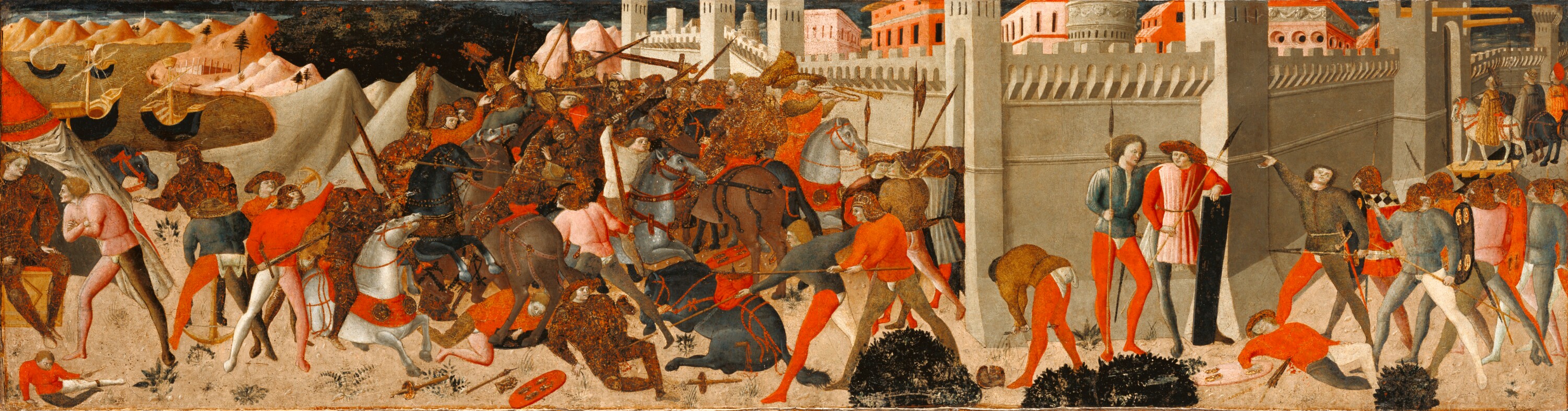
The Iliad (Ἰλιάς) is an epic [[poem]] from the 8th century BCE, attributed to Homer. As one of the oldest surviving pieces of literature, it is a foundational text for ancient political thought.
The Iliad tells a story from the 10th year of the Trojan War: the conflict between [[Achilles]] and [[Agamemnon]], and the consequences of Achilles’ subsequent withdrawal from battle. While the poem is primarily set during war, it is also a deeply political work: how can justice exist in a world governed by personal relationships, honor, and force — rather than political institutions or moral norms?
Synopsis
The Trojan War begins after Paris, prince of Troy, seizes Helen from Menelaus, king of Sparta. In response, the Achaean kings lead an expedition against Troy, commanded by [[Agamemnon]], who is king of Mycenae and the brother of Menelaus.
By the time the poem begins, the war is soon to begin its tenth year, and the Achaeans have not yet captured Troy. However, they have raided surrounding towns and taken captives as war prizes. Among these are Chryseis — awarded to Agamemnon — and Briseis — awarded to Achilles, the greatest individual warrior among the Greek troops.
Book I
SING, goddess, the anger of Peleus’ son Achilleus
and its devastation, which put pains thousandfold upon the Achaians.
Chryseis’s father, a priest of Apollo, comes to ransom his daughter. However, Agamemnon refuses and doubles down by insulting the priest. To defend the honor of his priest, Apollo sends a plague raging through the Greek armies for nine days. When the seer Kalchas explains the cause of the plague, Agamemnon agrees to return Chryseis but demands compensation.
Find me then some prize that shall be my own, lest I only
among the Argives go without, since that were unfitting;
you are all witnesses to this thing, that my prize goes elsewhere.
After Achilles suggests that “there is no great store of things lying about,” Agamemnon accuses Achilles of trying to cheat him. He threatens to seize the prizes of Achilles, Ajax, or Odysseus unless the Achaeans immediately provide him with a replacement for Chryseis. Achilles, in turn, only escalates the conflict:
And now my prize you threaten in person to strip from me,
for whom I laboured much, the gift of the sons of the Achaians.
Never, when the Achaians sack some well-founded citadel
of the Trojans, do I have a prize that is equal to your prize.
Always the greater part of the painful fighting is the work of
my hands; but when the time comes to distribute the booty
yours is far the greater reward.
Ultimately, Agamemnon seizes Briseis, and in a fit of rage, Achilles nearly draws his sword against him. The goddess Athena intervenes and restrains Achilles, who ends the confrontation by swearing that he will stop fighting for the Greeks. One day, he predicts, the sons of the Achaeans will long for his return.
Achilles’s weeping is heard by his mother, the sea nymph Thetis, who comes to comfort him. He asks her to persuade Zeus to favor the Trojans in the war, so that the Greeks will come to regret dishonoring him in their suffering. Thetis goes to Olympus and secures Zeus’s promise. Zeus temporarily placates his wife Hera, but she remains committed to the Greek cause. Therefore, Book I establishes the Trojan War as both a cosmic and human drama.
Book II
Now the rest of the gods, and men who were lords of chariots,
slept night long, but the ease of sleep came not to Zeus
who was pondering in his heart how he might bring honour
to Achilleus, and destroy many beside the shops of the Achaians.
Zeus decides that the best way to proceed is by sending a deceptive Dream to Agamemnon. Disguised as Nestor, a wise counselor, the Dream says that the gods are united in support of the Greeks, and that Troy can be taken immediately.
Agamemnon summons the Greek leaders and, in an interesting move, tells them that he will “make trial of [the troops] by words” (II.73–74). Before the entire assembly, he laments the failure of the expedition — nine years have gone by, and they have “no accomplishment shown for it” (II.122). He proposes that they sail home and abandon the war. The exhausted Greeks are nothing if not eager to listen to his words.
In another moment of cosmic intervention, Hera sends Athena to intervene. Odysseus takes Agamemnon’s sceptre to assert his authority, persuading the leaders and rebuking common soldiers. Against each soldier’s [[private judgment]], he insists that the Greeks must have a single ruler:
Surely not all of us Achaians can be as kings here.
Lordship for many is no good thing. Let there be one ruler,
one king, to whom the son of devious-devising Kronos
gives the sceptre and right of judgment, to watch over his people.
In the restored assembly, Thersites, an ordinary soldier known for his unhinged speech, attacks Agamemnon. He accuses the king of greed and recalls his mistreatment of Achilles.
It is not right for
you, their leader, to lead in sorrow the sons of the Achaians.
My good fools, poor abuses, you women, not men, of Achaia,
let us go back home in our ships, and leave this man here
by himself in Troy to mull his prizes of honor.
While he repeats many of the criticisms that Achilles raised, Thersites does not enjoy the same status in the army, and his speech is seen as unacceptable in the aristocratic order. Odysseus insults Thersites, threatens to strip his clothing and whip him, and strikes him with Agamemnon’s sceptre as the other soldiers laugh.
But now this is far the best thing [Odysseus] has accomplished
among the Argives, to keep this thrower of words, this braggart
out of assembly. Never again will his proud heart stir him
up, to wrangle with the princes in words of revilement.
The book continues with Odysseus rallying the troops, recalling a prophecy that the Greeks will take Troy in the tenth year. Nestor advises Agamemnon to organize the army by tribes and clans, and the army breaks to eat and ready themselves for battle. Agamemnon, meanwhile, prays that he will capture Troy and kill Hector before sunset, but Zeus does not grant the prayer.
The poem then breaks for the Catalogue of Ships, an account of the Greek contingents, commanders, and strengths. Zeus, meanwhile, warns the Trojans to organize, and the book concludes with a corresponding catalogue of the Trojan forces.
Book XVIII
A messenger brings Achilles the news that he most fears: his friend Patroklos is dead, the Greeks and Trojans are fighting over his body, and Hector has seized Achilles’s armor. Achilles collapses in grief: he covers himself with dust and cries out so violently that the messenger holds his hands, fearing that Achilles may kill himself. Thetis, hearing Achilles’s cries, comes to Achilles, who tells her that Zeus’s will has been done.
All these things the Olympian brought to accomplishment.
But what pleasure is this to me, since my dear companion has perished,
Patroklos, whom I loved beyond all other companions,
as well as my own life.
Achilles declares that he will kill Hector, though he knows that he is to die soon thereafter. He regrets his withdrawal from the Greek army, since he “was no light of safety to Patroklos, nor to [his] other companions, who in their numbers went down before glorious Hektor” (XVIII.102-103). He decides to let his anger with Agamemnon “be a thing of the past” (112), redirecting his anger toward Hector and the Trojans. Thetis supports Achilles’s decision, but warns him not to re-enter battle until she returns with new armor made by Hephaestus.
In the meantime, Achilles, surrounded by Athena’s aegis and covered by a blazing cloud, shouts thrice at the Trojans. They recoil in terror, and the Greeks recover Patroklos’s body. Achilles places his hands on his friend’s chest “with outbursts of incessant grief” (318). He promises that he will not bury him until he has killed Hector and returned with both his armor and his head.
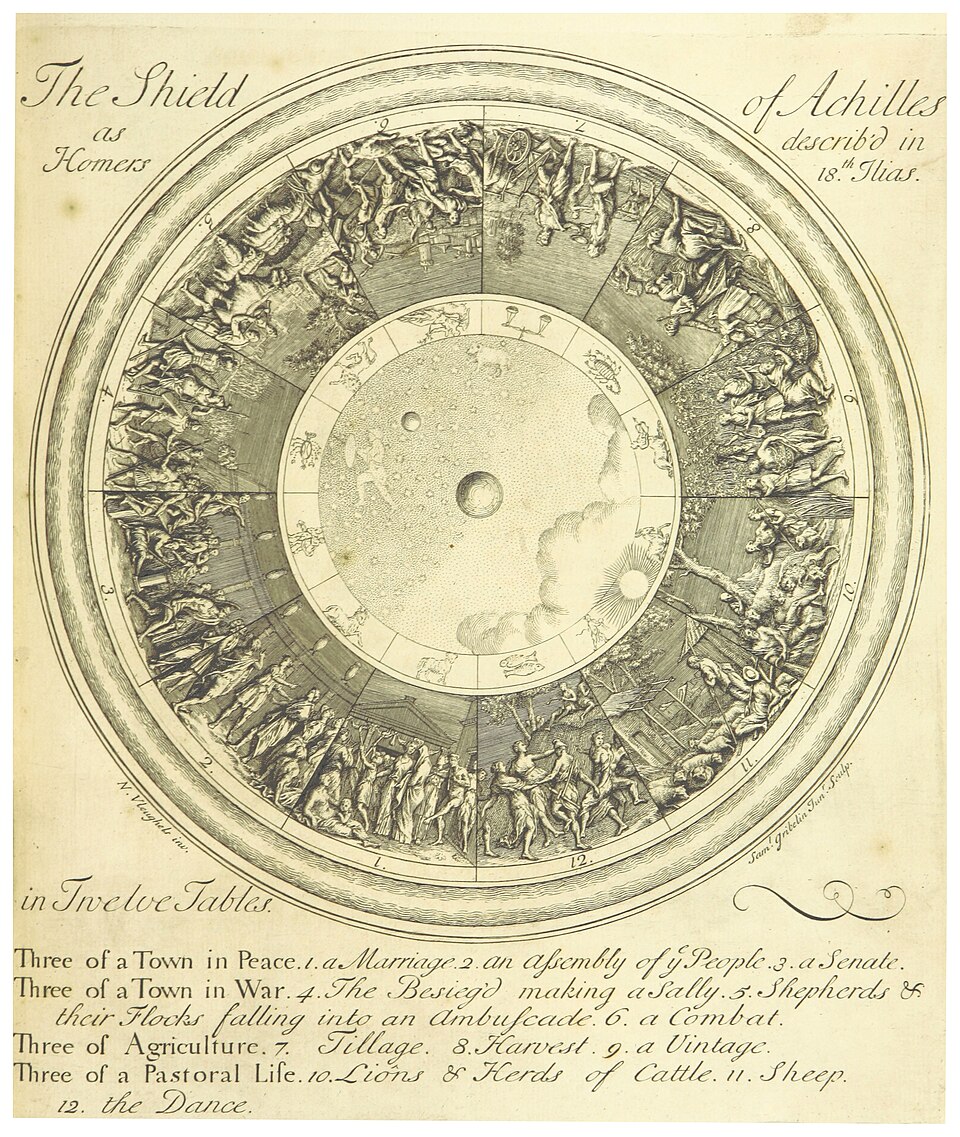
Hephaestus forges a shield for Achilles, since he owes a favor to Thetis, who rescued him after he was cast from Olympus. At its center are the earth, sea, sky, sun, moon, and stars. Around them are two cities, one at peace, and one at war.
The city at war features scenes of armies, ambushes, violence, and ultimately death. The city at peace features weddings and dancing. But it is not free of conflict, as in the marketplace, “two men were disputing over the blood price for a man who had been killed” (498-499).
One man promised full restitution
in a public statement, but the other refused and would accept nothing.
Both then made for an arbitrator, to have a decision;
and people were speaking up on either side, to help both men.
The shield also contains scenes of ploughing, harvesting, grape gathering, cattle herding, sheep pastures, music, and dance. And its outermost rim is formed by the river Ocean. As such, the shield is an entire human world, with the juxtapositions of peace and war, justice and violence, nature and society. As Achilles is about to reenter battle in this pivotal moment, he will carry an image of a complete life that he is abandoning in the pursuit of vengeance.
Methods
What does it mean to read poetry as political theory? Specifically, what does it mean for poetry to be doing political work? As Ryan Balot writes:
All of Greek political literature is normative.1
As part of the oral tradition, The Iliad served a didactic function, imparting moral and political wisdom to its audiences. Thus, even if the epic does not concern itself with formal political institutions, its dramatic conflicts present reflections on justice and leadership that would be important to inhabitants of the early polis.
Analysis
The world of The Iliad is a heroic political order.2 Homeric society is led by elite warriors and kings, and the authority of individuals depends on their rank, reputation, and battlefield status.
Book I: Justice and Authority
The term for justice in The Iliad is dike (literally “the right way”), particularly as determined by custom.3 The book’s central conflict kicks off because Agamemnon and Achilles disagree on what this “right way” is, and there is no reliable way to resolve the conflict between these powerful leaders.
Agamemnon has [[authority]] without justice, as he is commander of the forces but uses his power badly and lets his hubris get to his head. Achilles, meanwhile, has justice without authority: while his grievance is legitimate, he does not have the means to overrule Agamemnon. Their conflict, then, is about both justice and honor, since Achilles objects to (what he perceives) as unfair treatment at the hands of Agamemnon.
Balot describes this tension as between fairness on the basis of rank (Agamemnon) and merit (Achilles). Achilles charges Agamemnon with two character defects: greed and hubris. He says that Agamemnon “devoured” his own people for the sake of his greed (1.231). Meanwhile, hubris is “a form of arrogant contempt designed to display superiority”4 — by sharing his “victimization,” Achilles aligns himself with the army as a whole, whom Agamemnon is oppressing. The takeaway in Balot’s view is that the poem demonstrates that the character and emotions of individuals must be managed — even that of leaders — to have a well-functioning and norm-abiding community.
Ultimately, Athena intervenes to stop Achilles from killing Agamemnon in his fit of rage. Without proper human institutions to adjudicate between their claims, divine intervention becomes the substitute (as it does many times in The Iliad). Meanwhile, Achilles’ withdrawal damages the entire Greek army, so this personal dispute between the two turns into a collective political crisis.
Book II: The Power to Speak
After receiving Zeus’s dream, Agamemnon tests the troops by suggesting that they return home, but the plan nearly backfires when the wider army takes his suggestion too eagerly. This episode may suggest the difficulties of mass cooperation.
Thersites, in the entire assembly, criticizes Agamemnon for greed and irresponsible leadership. While his criticism overlaps with that levied by Achilles before his withdrawal, he is nonetheless mocked and beaten because he lacks heroic status — in fact, Odysseus’s status as a hero is reinforced because he puts Thersites in his place, so to speak. The political question at stake is: who can speak? Evidently, as a “regular soldier,” Thersites’ rank matters more than the truth of his criticism.
Covenants and Oaths
Where then shall our covenants go, and the oaths we have taken?
In a condition where there is no mechanism to making commitments to future courses of action credible, there is always the risk of anarchy in a Homeric society. Here, for example, Nestor asks what happens to the Greeks’ agreements if the Achaeans are all to renege on their mission to take Troy. Thus, there is a need for some other regulatory mechanism that allows for [[credible commitment]] across time.
The [[oath]] is the solution for this, since it brings humans into a relationship with the divine realm. A false oath insults the honor of the gods by which one swears, and the events of Book I (Apollo’s revenge) indicate that when human justice fails, divine justice can always intervene. Oaths then bring in gods as third-party enforcers to (human) social agreements, making possible some degree of credible commitment to future actions.
The City on the Shield
As depicted on the shield made by Hephaestus for Achilles, the “city at peace” is not one without conflict.
The people were assembled in the market place, where a quarrel
had arisen, and two men were disputing over the blood price
for a man who had been killed. One man promised full restitution
in a public statement, but the other refused and would accept nothing.
Both then made for an arbitrator, to have a decision;
and people were speaking up on either side, to help both men.
But the heralds kept the people in hand, as meanwhile the elders
were in session on benches of polished stone in the sacred circle
and held in their hands the staves of the heralds who lift their voices.
The two men rushed before these, and took turns speaking their cases,
and between them lay on the ground two talents of gold, to be given
to that judge who in this case spoke the straightest opinion.
In the city, justice is a public and participatory practice, rather than the private will of an individual (or his rage, even). Political authority is distributed among the litigants, citizens, and elders, with the legitimacy of the scene emerging from its structured deliberation (for example, the elders make sure that the citizens follow protocol). Fairness here is not about impartiality, but about the right balance among necessarily partial views. What keeps this city one at peace is that violent conflict can nonetheless be transformed into civic procedure.
Footnotes
N.B. This note uses Lattimore’s translation, as found on the Chicago Homer Project.