Works and Days
Works and Days (Ἔργα καὶ Ἡμέραι) is a poem by Hesiod, written around 700 BCE. In the poem — part farmer’s almanac, part mythology, and part moral education — Hesiod instructs his brother Perses on how he should live his life.
In the poem, Hesiod states that he and his brother are the heirs of a farm together. However, Perses has bribed a judge in his favor to obtain Hesiod’s portion as well. Instead of giving his brother money or property, which Hesiod sees as a futile effort, he decides to teach him the virtues of work and impact his brotherly wisdom.
Synopsis
Invocation
The poem begins with an invocation to the muses of Pieria, and to their father, Zeus, who controls the fates of mankind.
Through him mortal men are famed or un-famed, sung or unsung alike, as great Zeus wills. For easily he makes strong, and easily he brings the strong man low; easily he humbles the proud and raises the obscure, and easily he straightens the crooked and blasts the proud.1
After this appeal to Zeus — he who “make[s] judgments straight with righteousness” — Hesiod begins his undertaking to “tell of true things” to his brother, Perses.2
Two forms of strife
While Works and Days concerns itself with human affairs, Hesiod begins the poem by referencing the cosmic lineage in Theogony. There are two forms of Strife (Ἔρις) on earth: one “fosters evil war and battle,” while the other “stirs up even the shiftless to toil.”3
For a man grows eager to work when he considers his neighbor, a rich man who hastens to plough and plant and put his house in good order; and neighbor vies with his neighbor as he hurries after wealth. This Strife is wholesome for men. And potter is angry with potter, and craftsman with craftsman, and beggar is jealous of beggar, and minstrel of minstrel.4
Hesiod encourages Perses to avoid taking delight in strife, telling him to not “peep and peer and listen to the wrangles of the court-house.”5 Instead, Hesiod suggests, he should focus on working for his livelihood.
Bribe-swallowing lords
Nay, let us settle our dispute here with true judgement which is of Zeus and is perfect.6
Hesiod gets to business by revealing that they had “already divided our inheritance,” but Perses was able to claim more than his fair share through influencing “bribe-swallowing lords who love to judge such a cause as this.”7
These judges, Hesiod says, “know not how much more the half is than the whole, nor what great advantage there is in mallow and asphodel.”8 To further convince Perses of the necessity of work — as well as the cosmic justice that underlies it — Hesiod begins his mythology.
Prometheus and Pandora
Upset that [[Prometheus]] stole fire for humanity, [[Zeus]] decides that he will “give men as the price for fire an evil thing.”9 He orders the gods to create Pandora, a beautiful woman who is endowed with gifts from all of the Olympians. Hermes brings Pandora to Epimetheus (Prometheus’s brother) as a gift, and, despite Prometheus’s warning to never accept a gift from Zeus, he accepts. Pandora opens a jar that releases sickness, toil, misery, and “countless plagues” into a world previously free of suffering. Only Hope remains within the lid — “by the will of Aegis-holding Zeus”10 — leaving humanity subject to hardship for all eternity.
Perhaps as a note to his brother, Hesiod concludes that “there is no way to escape the will of Zeus.”11
Myth of the ages
Next, Hesiod tells the Myth of the Ages, a story of the progression of humans from near-divine existence to the current period, which is beset by trouble and toil.
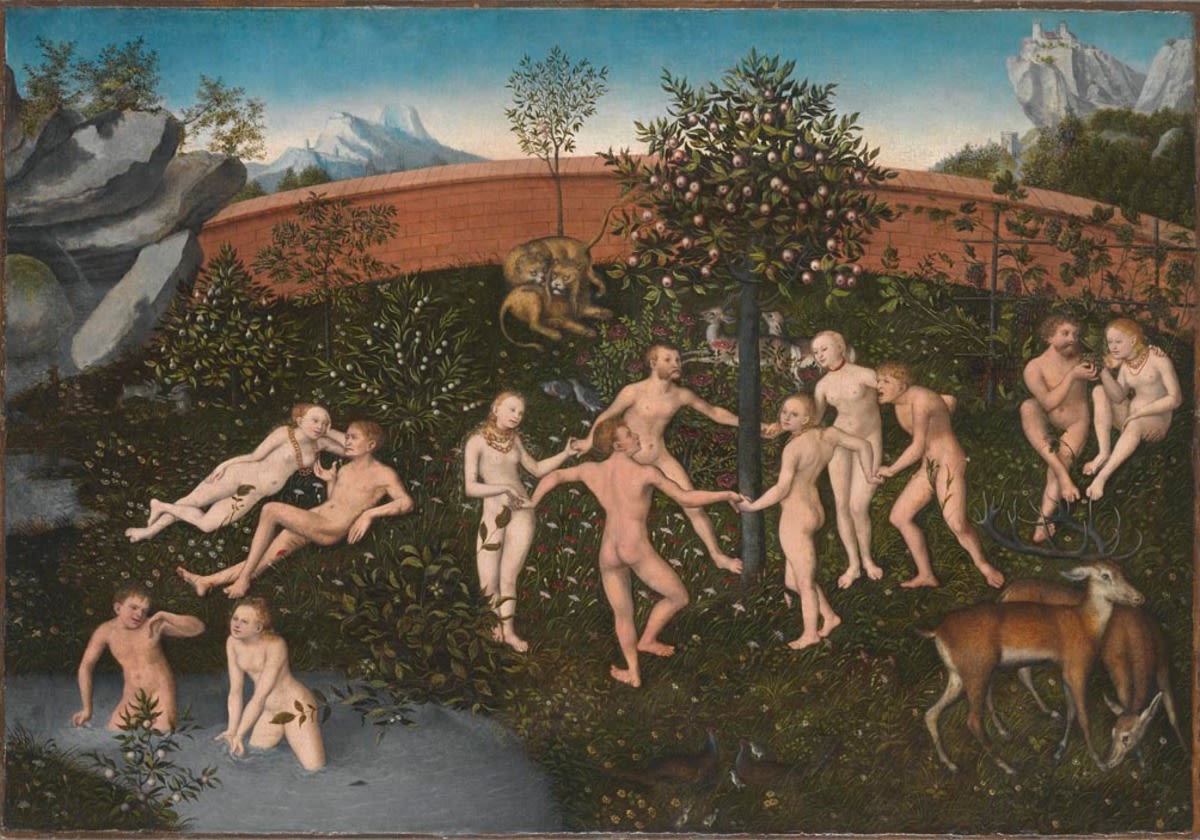
Golden age
And they lived like gods without sorrow of heart, remote and free from toil and grief: miserable age rested not on them; but with legs and arms never failing they made merry with feasting beyond the reach of all evils.12
The golden age dates to the time of [[Cronos]]. Humans had a near-godly existence, and the plentiful resources of the earth meant peace among all men. When humans died, it was as though they went to sleep; after this age came to a close, the golden men became “pure spirits dwelling on the earth,” protecting mankind from evils and granting them wealth.13
Silver age
This generation was “less noble by far,” as they were “like the golden race neither in body nor in spirit.”14 As “utter simpletons,” Men lived with their mothers for a hundred years; afterwards, they would live but short lives “because of their foolishness.” Silver men could “not keep from sinning and from wronging one another,”15 and they refused to honor and obey the gods. Thus, Zeus destroyed the race, and they became spirits of the underworld.
Bronze age
They loved the lamentable works of Ares and deeds of violence; they ate no bread, but were hard of heart like adamant, fearful men. Great was their strength and unconquerable the arms which grew from their shoulders on their strong limbs.16
The men of the Bronze Age were “terrible and strong,”17 with bronze armor, houses, and weapons. Their warlike disposition meant that they destroyed each other, leaving no legacy.
Heroic age
The race of heroes — the only without a metal in its name — was “nobler and more righteous.”18 It is also the only age that improves on its preceding one. Although the men of this age were demi-gods, they fell in war, such as at [[Thebes]] and Troy. After their deaths, they live in the islands of the blessed, where “the grain-giving earth bears honey-sweet fruit flourishing thrice a year.”19
Iron age
For now truly is a race of iron, and men never rest from labour and sorrow by day, and from perishing by night; and the gods shall lay sore trouble upon them.20
Finally, Hesiod laments that he is alive during the so-called Iron Age (wishing that he “either had died before or been born afterwards”). Zeus will also destroy this race, he predicts. Society at that point will have fallen into total moral and religious decline. Children will dishonor their parents, oaths will be broken, and strength will overcome justice.
There will be no favor for the man who keeps his oath or for the just or for the good; but rather men will praise the evil-doer and his violent dealing. Strength will be right and reverence will cease to be.
The hawk and the nightingale
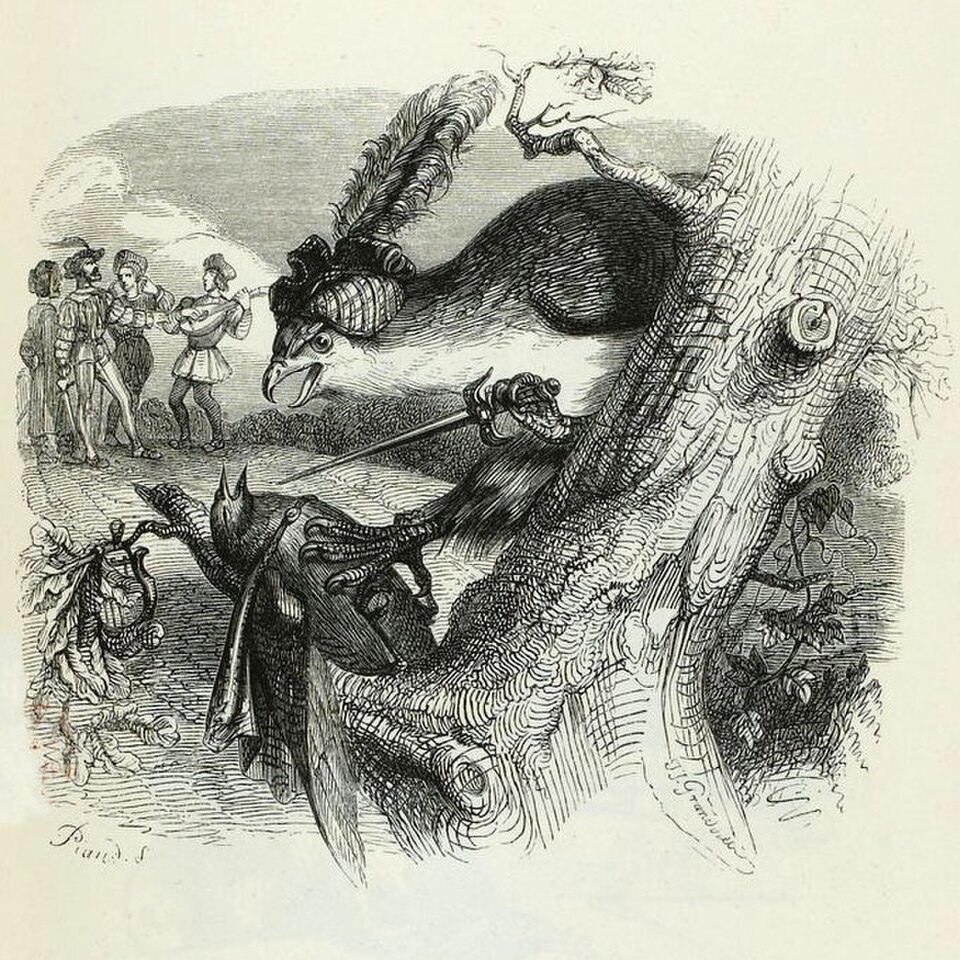
Hesiod then addresses the princes directly. A hawk flies high in the air, with a nightingale in its talons. The smaller bird “cries pitifully,” to which the hawk responds:21
Miserable thing, why do you cry out? One far stronger than you now holds you fast, and you must go wherever I take you, songstress as you are. And if I please I will make my meal of you, or let you go. He is a fool who tries to withstand the stronger, for he does not get the mastery and suffers pain besides his shame.22
On justice
Hesiod then addresses his brother directly: violence and injustice will destroy a man, even a powerful or prosperous one, “for Justice beats Outrage when she comes at length to the end of the race.”23
Moreover, entire cities answer for the deeds of a single “bad man who sins and devises presumptuous deeds” — in these cases, Zeus brings “great trouble upon the people.”24 Speaking to the princes, Hesiod warns that Zeus’s eye — “seeing all and understanding all” — takes note of “what sort of justice is this that the city keeps within it.”25
When the personified Justice is mistreated, for example by judges who “devour bribes” and issue “crooked judgments” as in the current dispute, she follows a city “weeping” and bringing punishment upon it. On the other hand, cities with rulers who give “straight judgments” to foreigners and citizens alike flourish and their people proper.26
Neither famine nor disaster ever haunt men who do true justice; but light-heartedly they tend the fields which are all their care. The earth bears them victual in plenty, and on the mountains the oak bears acorns upon the top and bees in the midst. Their woolly sheep are laden with fleeces; their women bear children like their parents. They flourish continually with good things.27
Men are distinguished from animals in that animals devour one each other for lack of justice, but Zeus has given humanity the capacity to ordain right and wrong. Thus, “for whoever knows the right and is ready to speak it, far-seeing Zeus gives him prosperity.” On the other hand, as to “whoever deliberately lies in his witness and foreswears himself,” he is “harmed beyond repair.”28
On work
Hesiod finally turns to the difficulty of living well:
To you, foolish Perses, I will speak good sense. Badness can be got easily and in shoals: the road to her is smooth, and she lives very near us. But between us and Goodness the gods have placed the sweat of our brows: long and steep is the path that leads to her, and it is rough at the first.29
Work, Hesiod tries to convince his brother, is both morally good and materially necessary. Gods and men alike dislike idle men, “for in nature he is like the stingless drones who waste the labor of the bees.” And, work ensures that one will not starve. Thus, “work is no disgrace: it is idleness which is a disgrace.”30 Finally, recalling the opening of the poem, Hesiod advises his brother to stop coveting other people’s property: instead, he should “attend to your livelihood as I bid you.”31
The remainder of the poem is a collection of household, religious, and social rules. Hesiod advises honoring the gods32, respecting guests and parents33, maintaining good relations with neighbors34, repaying fairly35, gradual savings36, and bearing sons.37 He also advises against dishonest profit38, greediness39, and, in a reflection of the patriarchal nature of the poem, trusting “flaunting women.”40
Analysis
Hesiod concerns himself with matters of justice, which is facilitated through the gods, who are “ultimately responsible for rewarding the upright and punishing wrongdoers.”41
Footnotes
N.B. Our class reading was only through line 382 of the poem. Line numbers below follow the Perseus Scaife Viewer edition of Evelyn-White’s translation.
-
Hesiod. Homeric Hymns, Epic Cycle, Homerica. Translated by Hugh G. Evelyn-White. The Loeb Classical Library 57. Harvard University Press W. Heinemann, 1914. Lines 1–5. ↩
-
Lines 9–10. ↩
-
Lines 11–20. ↩
-
Lines 20–25. ↩
-
Lines 25–29. ↩
-
Lines 35–39. ↩
-
Lines 35–39. ↩
-
Lines 40–41. Referring to the poor man’s food. ↩
-
Lines 55–58. ↩
-
Lines 95–99. ↩
-
Line 105. ↩
-
Lines 110–119. ↩
-
Lines 120–125. ↩
-
Lines 125–129. ↩
-
Lines 130–135. ↩
-
Lines 145–149. ↩
-
Lines 144–145. ↩
-
Lines 155–159. ↩
-
Line 173. ↩
-
Lines 175–179. ↩
-
Lines 202–206. Note that the hawk is referred to as “he” and the nightingale as “she.” ↩
-
Lines 206–211. ↩
-
Lines 215–219. ↩
-
Lines 240–243. ↩
-
Lines 266–269. ↩
-
Lines 220–226. ↩
-
Lines 230–237. ↩
-
Lines 280–282. ↩
-
Lines 285–292. ↩
-
Lines 305–311. ↩
-
Lines 315–316. ↩
-
Lines 335–339. “As far as you are able, sacrifice to the deathless gods purely and cleanly, and burn rich meats also, and at other times propitiate them with libations and incense.” ↩
-
Lines 325–329. “Alike with him who does wrong to a suppliant or a guest.” ↩
-
Lines 345–349. “He who enjoys a good neighbor has a precious possession.” ↩
-
Lines 349–350. “Take fair measure from your neighbor and pay him back fairly with the same measure, or better, if you can.” ↩
-
Lines 361–363. “He who adds to what he has, will keep off bright-eyed hunger; for if you add only a little to a little and do this often, soon that little will become great.” (These lines are traditionally cited in this transposed order due to a suspected displacement in the manuscript tradition.) ↩
-
Lines 378–380. “Yet Zeus can easily give great wealth to a greater number. More hands mean more work and more increase.” ↩
-
Lines 320–326. “Wealth should not be seized: god-given wealth is much better; for if a man take great wealth violently and perforce, or if he steal it through his tongue…the gods soon blot him out.” ↩
-
Lines 355–356. “Give is a good girl, but Take is bad and she brings death.” ↩
-
Lines 372–374. “Do not let a flaunting women coax and cozen and deceive you: she is after your barn. The man who trusts womankind trust deceivers.” ↩
-
Balot, Ryan K. Greek Political Thought. 1st ed. Ancient Cultures Series. John Wiley & Sons, Incorporated, 2006. Page 21. Also note the beginning of Hesiod’s invocation to Zeus. ↩